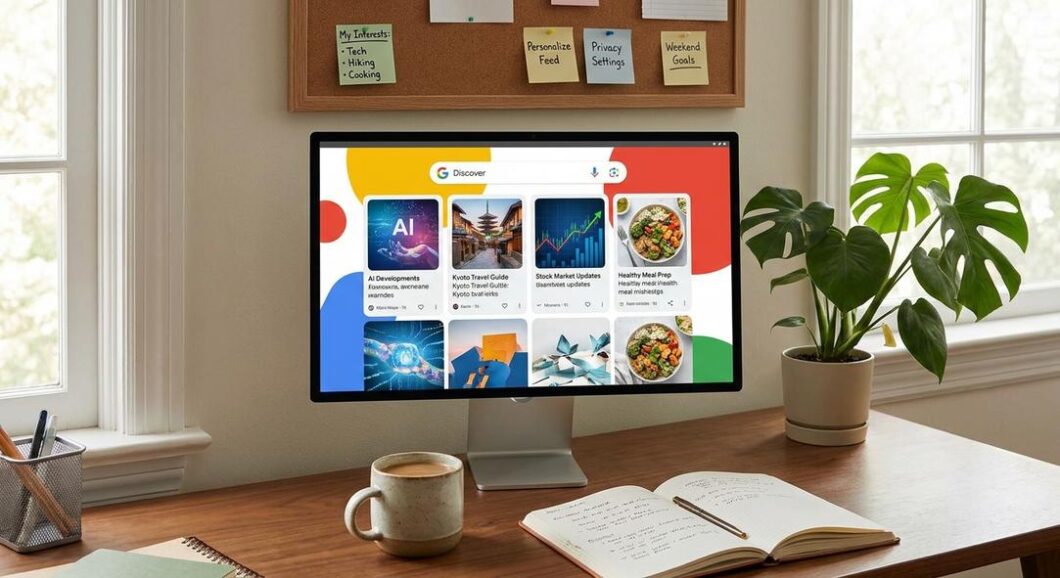
Google Discover Gets a More Personal Face 🔎
Google has spent years trying to make Search feel less like a blank box and more like a well-lit hallway into the internet. Now, with the introduction of Search profiles within Google Discover, the company is nudging that ambition into more visible territory: a personalized layer that helps users see, manage, and refine the interests shaping what appears in their Discover feed.
At first glance, the update may sound like another quiet interface tweak from Mountain View, the sort that arrives without confetti and later becomes impossible to imagine living without. But Search profiles could mark a meaningful shift in how Google explains personalization to users. Discover has always been powered by signals: what you read, where you go, what you search for, what you ignore. The difference now is that some of those signals may become easier to inspect and influence.
Key insight: Personalization is no longer just something that happens behind the curtain. Google is increasingly asking users to participate in shaping the machine that shapes their attention.
What Search Profiles Mean Inside Discover 🧭
Google Discover, for the uninitiated or the stubbornly minimalist, is the feed of articles, videos, sports scores, entertainment news, local updates, and niche fascinations that appears in the Google app and on many Android home screens. It is not Search in the traditional sense. You do not type a question; Google simply offers what it thinks you might want before you ask.
The new Search profiles concept appears designed to make that experience more coherent. Instead of Discover feeling like a mysterious stew of past clicks and algorithmic hunches, profiles can serve as a kind of interest map. They may highlight topics connected to a user’s activity, making it easier to understand why certain stories keep resurfacing and how to adjust the feed when it veers into irrelevance.
For users, that could mean more direct control over recurring themes such as technology, travel, finance, recipes, health, celebrities, gaming, or local news. It could also mean fewer moments of digital bewilderment, such as being shown six articles about sourdough starters because of one regrettable late-night search during a rainy weekend.
The Quiet Power of Discover 📱
Discover is sometimes underestimated because it does not have the cultural drama of TikTok, the political volatility of X, or the professional varnish of LinkedIn. Yet its influence is enormous. For many publishers, Discover can send sudden waves of traffic. For users, it has become a casual morning ritual: thumb, glance, tap, repeat.
Unlike classic Search, where intent is explicit, Discover is built around prediction. That makes it powerful, but also more delicate. When Google gets it right, the feed feels uncannily useful. When it gets it wrong, it can feel like being followed around a bookstore by a clerk who keeps recommending books based on one conversation you barely remember having.
-
Search is reactive: users ask, Google answers.
-
Discover is anticipatory: Google suggests before users ask.
-
Search profiles bridge the two: they may turn passive personalization into something users can better understand and guide.
This distinction matters. The future of Google is not only about finding information quickly. It is about arranging information in ways that feel timely, relevant, and personally meaningful without becoming claustrophobic.
Why Transparency Is the Real Product 🪟
The most interesting part of Search profiles may not be the profile itself, but the promise of greater transparency. For years, internet users have grown accustomed to platforms knowing them with unnerving precision while explaining that knowledge in vague, fog-machine language. “Based on your activity” has become the digital equivalent of a shrug.
If Google uses Search profiles to show users what categories, entities, or patterns are shaping Discover, it could reduce some of that ambiguity. More importantly, it could give people a stronger sense of agency. A user who no longer wants updates about a former hobby, an old job search, or a celebrity scandal that briefly hijacked their curiosity may be able to steer Discover away from those subjects more cleanly.
“The best personalization tools are not the ones that pretend to know everything,” a digital media analyst might say. “They are the ones that let users correct the record.”
That line captures the challenge. Personalization is only useful when it remains flexible. Human beings are inconsistent, seasonal, contradictory creatures. We develop obsessions and abandon them. We research symptoms and then wish the internet would stop diagnosing us. We plan trips, change careers, buy gifts, and accidentally train algorithms to think we have become different people.
A New Lever for Publishers and Creators 📰
For publishers, the arrival of Search profiles inside Discover could be both opportunity and warning. Discover traffic has always had a certain lottery-ticket quality. A story can surge without warning, then vanish just as quickly. If user profiles become more refined, content may reach more precisely interested audiences, but the competition for relevance could grow sharper.
This may reward publishers who develop strong topic authority and consistent coverage. If Google better understands that a user has a durable interest in climate policy, electric vehicles, personal finance, or European football, it may also become better at matching that interest with sources that reliably serve it.
But there is a catch. Greater personalization can also narrow discovery. A user who is repeatedly shown familiar topics may become less likely to encounter surprising or challenging material. For news organizations, the question is whether Discover can balance relevance with breadth, comfort with serendipity.
-
Authority may matter more: consistent expertise could help content align with user interest profiles.
-
Headlines still matter: Discover remains a visual, fast-moving environment where presentation influences attention.
-
Diversity is a risk point: highly personalized feeds can become too narrow if not carefully designed.
The Privacy Question, Inevitably 🔐
No Google personalization story can avoid the privacy question, nor should it. Search profiles inside Discover raise familiar concerns: What data is being used? How visible is it to the user? Can it be edited, paused, or deleted? Is the profile stored in a way that feels understandable, or does it become yet another setting buried three menus deep beneath a cheerful icon?
Google has spent the past several years emphasizing user controls, privacy dashboards, auto-delete options, and clearer explanations of ad personalization. Search profiles fit naturally into that broader effort, but execution will matter. A control panel is only empowering if ordinary people can find it, understand it, and trust that changes actually mean something.
The privacy test is simple: if users can see why they are being shown something and change that logic without needing a manual, the feature is doing its job.
There is also a philosophical issue. The more visible personalization becomes, the more users may realize just how much of their online experience is being quietly arranged. That realization can be useful, even healthy. But it can also be unsettling. Google must make the feature feel less like a dossier and more like a dashboard.
Personalization Without the Rabbit Hole 🐇
The central tension of Discover has always been the same: people want relevance, but not confinement. They want the internet to remember what they love, not trap them inside it. Search profiles may help if they function as adjustable lenses rather than locked rooms.
A good Discover feed should have texture. It should know that a user follows Formula 1, but occasionally offer a thoughtful essay about urban design. It should remember an interest in healthy recipes without becoming a 24-hour quinoa broadcast. It should notice curiosity, but not mistake every passing click for a personality trait.
This is where Google’s editorial responsibility, though algorithmic, becomes significant. The company is not merely ranking pages; it is designing habits. The placement of a story, the repetition of a topic, the decision to surface or suppress novelty: these small choices help shape what millions of people learn, worry about, buy, and discuss.
What Users Should Watch For 👀
As Search profiles appear within Discover, users should pay attention to how much control the feature actually provides. The most useful version would be clear, editable, and responsive. It would allow people to remove stale interests, tune topic frequency, and understand the relationship between Search activity and Discover recommendations.
-
Look for options that explain why a topic or story appears.
-
Check whether interests can be edited or dismissed directly.
-
Review privacy and activity settings connected to Search and Discover.
-
Notice whether the feed becomes more useful over time, or merely more repetitive.
The best way to judge the feature is not by the elegance of its interface, but by the quality of the feed that follows. Does Discover become calmer, smarter, and more relevant? Or does it simply become better at showing more of the same?
A Small Feature With a Large Shadow 🌐
Search profiles within Google Discover may sound modest, but they sit at the crossroads of several big questions: how platforms personalize information, how users understand algorithmic influence, how publishers reach audiences, and how much control individuals really have over the feeds that fill their idle moments.
If Google gets this right, Discover could become less opaque and more genuinely useful: a feed that reflects interests without flattening identity, remembers preferences without clinging to them, and offers personalization without making the user feel personally studied. If it gets it wrong, Search profiles may become another decorative control in the grand theater of platform transparency.
For now, the move is worth watching. Google is not just changing a feature; it is refining the relationship between curiosity and prediction. In the age of algorithmic abundance, that relationship may be one of the most important interfaces we have.