AI in the Wild: Confident, Wrong, and Weirdly Expensive 🤖
The trouble with artificial intelligence is not that it is dull. Quite the opposite: it is dazzling, fluent, tireless, and occasionally so persuasive that it can make a falsehood sound like it has tenure at Oxford.
In the polished theater of product demos, AI feels like a miracle with a chat box. It summarizes legal documents, writes marketing copy, answers customer questions, diagnoses spreadsheet chaos, and generates images of astronauts riding horses on Mars with suspiciously good lighting. But outside the demo, in the fluorescent wilderness of actual work, something more complicated is happening. AI is proving useful, yes. It is also proving strange, brittle, expensive, and sometimes spectacularly overconfident.
What we are seeing now is not the clean arrival of a machine intelligence revolution. It is a messy deployment story: organizations rushing to install a technology that can produce value, confusion, and invoices at roughly the same speed.
The central paradox of modern AI is this: it can be astonishingly capable without being reliably trustworthy.
The Demo Is Not the Deployment 🎭
AI systems are very good at first impressions. They are the job candidate who interviews brilliantly, quotes the annual report, and then on day three accidentally emails a client a confident explanation of a policy that does not exist.
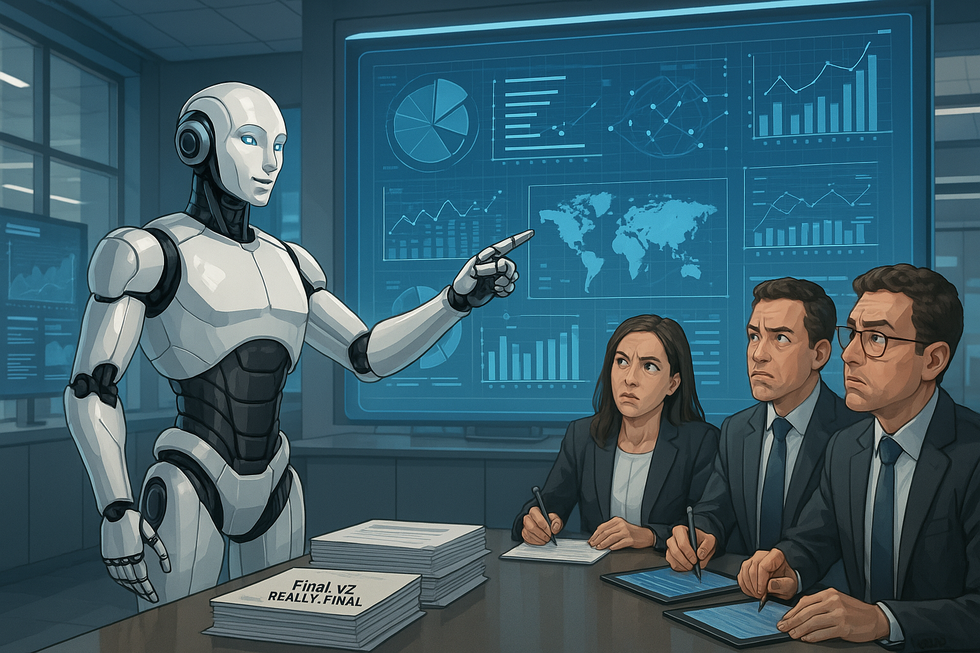
This gap between demonstration and deployment is where many organizations are now living. In a controlled setting, a chatbot can retrieve information, draft a memo, or produce a neat summary of a meeting. In the wild, it encounters outdated files, vague prompts, contradictory policies, edge cases, impatient users, and the ancient curse of corporate life: documents named “Final_v7_REALLY_FINAL.”
The result is not uselessness. It is unevenness. AI can save a worker twenty minutes in the morning and cost the legal department two hours in the afternoon. It can be a brilliant assistant on Monday and an overcaffeinated intern on Tuesday.
“AI does not fail like traditional software,” one technology executive told me. “It fails socially. It sounds plausible, so people believe it longer than they should.”
That is the uncomfortable novelty. Old software usually failed with a crash, an error message, or a spinning wheel of despair. Generative AI often fails by continuing to speak.
The Confidence Problem 🧠
Human beings have a well-documented weakness for confidence. We reward the person who speaks clearly, looks calm, and uses enough nouns in a row to imply expertise. AI has mastered this performance. It does not hesitate. It does not blush. It does not say, “I’m not sure” unless carefully instructed, and sometimes not even then.
This is why hallucination is such a misleadingly whimsical word. It makes the problem sound like a machine briefly seeing pink elephants. In practice, hallucination means fabrication: invented citations, imaginary regulations, bogus case law, false product specifications, fake historical events, or customer-service answers delivered with the tonal authority of a maître d’ at a very expensive restaurant.
The danger is not merely that AI is wrong. Humans are wrong all the time, often before lunch. The danger is that AI can be wrong at scale, wrong with polish, and wrong in ways that are hard to detect because the surface is so clean.
-
It may summarize a document while missing the clause that matters most.
-
It may generate a medical note that sounds professional but includes details never mentioned.
-
It may answer a customer with a refund policy the company has never offered.
-
It may produce software code that works just long enough to become someone else’s crisis.
The problem becomes more acute when AI is placed between an institution and the public. A flawed internal draft is one thing. A flawed benefits decision, loan explanation, insurance response, or legal recommendation is another.
The Bill Arrives Wearing Sneakers 💸
Then there is the cost. For years, software taught companies to expect scale as a bargain. Once built, digital tools could spread cheaply. AI has complicated that story. Every query can carry a computational cost. Every generated answer consumes processing power. Every experiment invites another subscription, another vendor contract, another “enterprise tier” whose price is revealed only after a sales call and a mild loss of dignity.
AI is often sold as a productivity engine, and in some cases it is. But the economics are not always obvious. A tool that saves employees time may also require new spending on cloud infrastructure, data cleaning, cybersecurity, compliance reviews, model monitoring, training, and the quiet army of people needed to check whether the machine has just invented a supplier in Belgium.
AI may reduce the cost of producing text, images, and analysis, but it can increase the cost of verifying reality.
This is the weird expense at the heart of the AI boom. The output is cheap; the assurance is not. A draft can be generated in seconds. Confirming that it is accurate, lawful, appropriate, private, unbiased, and aligned with company policy may take much longer.
Businesses are discovering that “just add AI” is not a strategy. It is a procurement event followed by organizational indigestion.
When Automation Creates More Work 🛠️
There is a recurring pattern in technological history: a tool arrives promising to eliminate drudgery, and instead rearranges it. Email reduced the friction of communication and created a world in which everyone could be interrupted by everyone else forever. Smartphones put the office in our pockets and then politely set the pockets on fire.
AI may follow a similar path. It can automate tasks, but it can also create new ones: prompt writing, output checking, data labeling, exception handling, audit logging, model evaluation, and explaining to senior management why the chatbot called a loyal customer “a theoretical shipping anomaly.”
Inside companies, workers are adapting in practical and sometimes mischievous ways. Some use AI as a brainstorming partner. Others use it as a first-draft machine. Some distrust it entirely. Many are quietly developing the most valuable skill of the era: knowing when the machine is probably bluffing.
This is not resistance to innovation. It is workplace realism. Employees have learned that tools introduced as liberation often arrive with dashboards.
The hidden labor behind “effortless” AI ⚙️
Behind every smooth AI experience is a less glamorous layer of human labor. People prepare the data, write the guidelines, test the outputs, review the failures, and absorb the consequences when something goes wrong. The machine may appear autonomous, but autonomy often rests on a stack of invisible clerical work.
This matters because organizations frequently misprice AI by focusing on the subscription fee rather than the operating model. A chatbot is not just a chatbot. It is a policy decision, a data architecture problem, a security challenge, a training program, and a customer-experience experiment squeezed into a conversational interface.
The Risk Is Not Skynet. It Is Spreadsheet Chaos 📊
Public debate about AI often oscillates between science fiction apocalypse and venture-capital rapture. The more immediate risks are less cinematic. They involve broken workflows, privacy leaks, opaque decisions, inaccurate outputs, vendor lock-in, and the gradual normalization of systems nobody fully understands.
The most serious failures may not look dramatic. They may look like a thousand small errors accumulating in customer records, performance reviews, legal research, HR screening, clinical documentation, or financial reporting. A machine does not need to become conscious to cause trouble. It only needs to be embedded in a process where people stop checking it.
“The danger is not that AI replaces judgment,” a risk officer said. “The danger is that it imitates judgment well enough that people forget to use their own.”
There is also the question of accountability. If an AI system gives bad advice, who owns the mistake? The employee who trusted it? The manager who approved it? The vendor who built it? The executive who demanded AI adoption before the end of the quarter? Responsibility becomes foggy, and fog is where bad governance goes to breed.
How to Use AI Without Being Used by It 🧭
The answer is not to ban AI or embrace it with the serene smile of a conference keynote speaker. The answer is to treat it as a powerful but unreliable instrument: useful, fast, impressive, and in need of supervision.
Organizations that use AI well tend to be disciplined rather than dazzled. They ask boring questions, which is usually where wisdom hides. What problem are we solving? What happens if the answer is wrong? Who checks the output? What data is being used? Can we explain the decision? Can we switch vendors? How do we know whether this is actually saving money?
A sensible AI strategy should include a few unromantic principles:
-
Start with narrow use cases. AI performs best when the task is clearly defined and the consequences of error are manageable.
-
Keep humans in the loop where stakes are high. Human review is not a decorative feature; it is a safety mechanism.
-
Measure total cost, not just tool cost. Include verification, training, compliance, infrastructure, and maintenance.
-
Document failures. A system that only tracks success stories is not being managed; it is being flattered.
-
Train people to challenge the output. AI literacy is less about prompt tricks and more about disciplined skepticism.
The best users of AI are not the most enthusiastic. They are the most alert. They understand that productivity gains are real, but so are the traps. They use the machine to accelerate thought, not replace it.
The Future Will Be Useful, Awkward, and Uneven 🌍
AI is not a passing fad. Too many people have already found too many useful applications for that. It will become part of ordinary work in the same way search engines, spreadsheets, and messaging platforms did: gradually, then suddenly, then invisibly.
But the mythology needs correction. AI is not magic. It is not a synthetic oracle. It is not a universal intern, though it does share the intern’s ability to produce confident work that requires supervision. It is a statistical engine trained on the world’s digital residue, capable of extraordinary pattern-making and equally extraordinary nonsense.
The organizations that thrive will not be those that buy the most AI, announce the most pilots, or insert the word “agentic” into the most slide decks. They will be the ones that combine experimentation with restraint, ambition with audit, and automation with accountability.
In the wild, AI is not one thing. It is a mirror, a lever, a shortcut, a liability, and occasionally a very expensive way to discover that your data is a mess.
The machine is here, and it is already changing work. It can help us move faster, think differently, and solve problems that once seemed too tedious to touch. But speed is not the same as direction, and fluency is not the same as truth.
So perhaps the first rule of living with AI should be simple: admire the performance, check the facts, and always read the invoice.