Google’s Expanded Candidate Set and the Selection Crisis 🔎
For most of its life, Google’s magic trick was deceptively simple: take the unimaginable mess of the web and return ten blue links that felt, on a good day, as if they had been arranged by a very fast librarian with mild telepathic powers.
That bargain has changed. Google no longer merely searches the web; it interprets, summarizes, recommends, predicts, and increasingly answers. Behind that shift sits a less glamorous but enormously consequential development: the expanded candidate set. In plain English, Google is looking at more possible answers, more content types, more entities, more passages, more videos, more forum posts, more shopping results, more local signals, and more machine-generated interpretations before deciding what deserves the user’s attention.
The result is not simply better search. It is a selection crisis. When the pool of possible answers grows vast enough, the central problem is no longer finding information. It is choosing among too much of it.
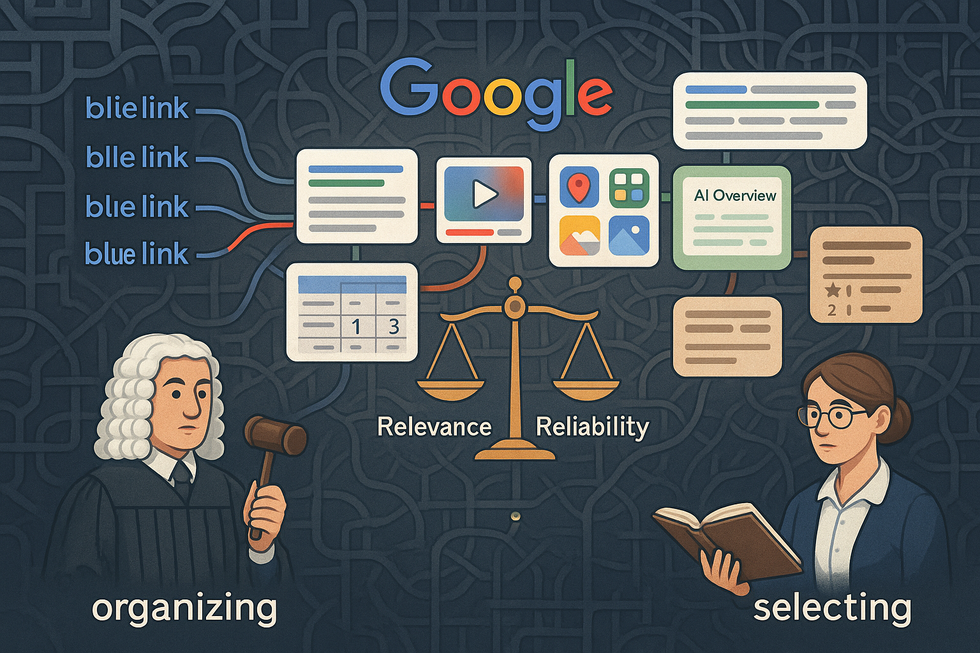
Search used to be a map. Increasingly, it is a judge. And like all judges, it now faces the problem of what evidence to admit.
From Indexing the Web to Curating Reality 🧭
Google’s original challenge was scarcity. In the late 1990s and early 2000s, the web was expanding wildly, but search tools were primitive. The genius of PageRank was that it converted links into a rough proxy for trust. If enough sites pointed to a page, perhaps that page mattered. It was not perfect, but it was elegant, mathematical, and wonderfully scalable.
Today’s search environment is different. The web is no longer just documents and links. It is structured data, apps, videos, reviews, social chatter, product feeds, maps, images, snippets, PDFs, podcasts, and machine-readable entities. Google must decide not only which page ranks first, but whether a page should appear at all, whether a video is more useful, whether a Reddit thread is more authentic, whether an AI-generated overview should precede everything, or whether the answer should be delivered without a click.
This is what makes the expanded candidate set so important. Google’s systems can now consider a broader universe of possible responses to a query. A search for “best running shoes for flat feet” may summon product pages, medical advice, YouTube reviews, forum discussions, local stores, shopping ads, comparison charts, AI summaries, and user-generated anecdotes. Each candidate competes not just for ranking, but for format, visibility, and authority.
In the old model, the question was: Which page deserves to rank? In the new model, the question is: What kind of answer should exist?
The Candidate Set Gets Bigger, and So Do the Stakes ⚖️
An expanded candidate set sounds like progress, and in many ways it is. A search engine that considers more evidence should, in theory, make better decisions. If Google can evaluate passages instead of whole pages, it can surface a precise answer buried deep inside a long article. If it can understand entities, it can connect people, places, products, and concepts more intelligently. If it can incorporate freshness signals, it can respond to breaking news faster.
But scale has a mischievous habit: it creates new problems while solving old ones. When Google evaluates more candidates, the act of selection becomes more complex and less transparent. A publisher may produce the most authoritative article on a topic and still be outranked by a forum comment, a video carousel, an AI summary, or a shopping module. The competition is no longer only other websites. It is the interface itself.
This matters because visibility on Google is not a vanity metric. For many businesses, newsrooms, scholars, creators, and public institutions, it is oxygen. A subtle change in candidate selection can move traffic, revenue, and influence at continental scale. Search rankings have always mattered, but the modern search results page is less like a list and more like a crowded airport terminal: announcements, kiosks, VIP lanes, security checks, advertisements, and the occasional lost traveler clutching a boarding pass.
The crisis is not that Google has too little information. The crisis is that Google has too many plausible ways to answer, and each one redistributes power.
Why “More Relevant” Is Not Always More Reliable 🧠
One of the central tensions in modern search is the difference between relevance and reliability. Relevance asks whether something matches what a user appears to want. Reliability asks whether it deserves to be trusted. These are cousins, not twins.
A lively forum answer may be relevant because it uses natural language, reflects lived experience, and directly addresses a narrow question. But it may also be wrong, anecdotal, outdated, or confidently unhinged. A peer-reviewed paper may be reliable, but incomprehensible to a general reader. A brand’s product page may be polished and structured, but self-interested. A news article may be current, but incomplete. An AI summary may be convenient, but dependent on what it chooses to compress and omit.
As Google expands its candidate set, it must weigh these competing virtues. Should it reward expertise, freshness, popularity, originality, proximity, authority, engagement, user satisfaction, or clarity? The honest answer is: all of them, but not equally, and not always in ways outsiders can observe.
This is where the selection crisis becomes epistemological, a word that sounds like it should come with a grant application but simply means: how do we know what we know? Google is not only ranking content. It is shaping the conditions under which knowledge becomes visible.
The Rise of the Answer Layer 🤖
The most visible expression of this shift is the rise of the answer layer: featured snippets, knowledge panels, direct answers, “People also ask,” and now AI-generated summaries. These features compress the web into immediate responses. For users, this can be splendid. Nobody wants to read a 2,000-word preamble to find out how many tablespoons are in a cup.
Yet the answer layer also changes the economic and cultural bargain of search. Websites provide the raw material; Google provides the synthesis; users may never visit the source. The web becomes less a destination than a quarry. This is not entirely new, but generative AI intensifies it. When an AI overview digests multiple sources into a single paragraph, the selected candidates may become invisible scaffolding.
For publishers, this creates a strange incentive structure. They must produce useful, original, trustworthy material, but the reward for usefulness may be extraction rather than traffic. A page can be good enough to train or inform an answer, but not prominent enough to receive the reader.
In the answer-layer era, being cited is better than being ignored, but it is not the same as being visited.
This is the heart of the modern selection crisis. Google must choose not only what to show, but how much of the source ecosystem it can safely absorb without weakening the very web it depends on.
SEO in the Age of Too Many Candidates 🛠️
For search professionals, the expanded candidate set has made old certainties wobble. Keywords still matter, but they no longer explain enough. Technical health still matters, but it is merely the price of admission. Links still matter, but authority now competes with user intent, entity recognition, topical depth, content format, brand signals, and real-world credibility.
The practical implication is that optimization has become less about tricking a ranking system and more about surviving a selection environment. A page must make itself legible to machines, persuasive to humans, distinctive among competitors, and credible in ways that extend beyond the page itself.
That means the strongest strategies increasingly share several traits:
- Clear topical authority: not one lonely article, but a coherent body of work that shows depth and expertise.
- Original value: data, reporting, testing, lived experience, analysis, or tools that cannot be easily paraphrased from elsewhere.
- Format awareness: understanding whether a query is better served by text, video, comparison tables, local results, product feeds, or concise answers.
- Trust signals: transparent authorship, citations, editorial standards, reviews, credentials, and consistent brand presence.
- User satisfaction: content that answers the real question quickly without treating readers like hostages in an ad maze.
The old SEO fantasy was that one could discover the secret lever and pull it. The new reality is more demanding and, frankly, healthier: build something worth selecting.
Small Sites, Big Brands, and the Visibility Squeeze 🌱
The expanded candidate set also raises an uncomfortable question: does a broader pool create more opportunity, or does it make dominance easier for already powerful players?
In theory, considering passages, forums, niche expertise, and varied formats should help smaller voices surface. A specialist blog can answer a question better than a generalist giant. A local expert can outshine a national directory. A passionate community can reveal truths no polished brand page would dare mention.
In practice, however, selection systems often favor signals that large entities possess in abundance: brand recognition, link authority, structured data, publishing volume, historical engagement, and cross-platform presence. Even when Google tries to reward hidden gems, the machinery of trust can tilt toward the familiar. The web’s long tail gets indexed, but not always invited to dinner.
This produces a squeeze. Small publishers must be original enough to stand out, authoritative enough to be trusted, fast enough to stay current, and technically polished enough to be understood. Meanwhile, large platforms can rank with thinner contributions because their surrounding reputation does some of the heavy lifting.
A larger candidate set does not automatically democratize search. Democracy depends on the rules of selection, not the size of the ballot.
The Human Problem Inside the Machine 👥
It is tempting to describe all of this as an engineering problem. More candidates require better models. More formats require better classification. More spam requires better detection. All true. But the selection crisis is also a human problem because search is full of value judgments masquerading as technical decisions.
What counts as expertise? When should consensus prevail over dissent? How should personal experience be weighed against institutional authority? Should controversial topics prioritize safety, neutrality, diversity, or official sources? When does convenience become overreach? These are not questions an algorithm can answer without inheriting assumptions from its designers, evaluators, training data, and business model.
Google operates at a scale where even minor preference shifts have public consequences. If it boosts forums, publishers complain. If it boosts publishers, users may complain that results feel sanitized. If it boosts AI answers, creators fear disappearance. If it boosts brands, independent sites cry monopoly. If it boosts novelty, reliability may suffer. If it boosts authority, freshness may lag.
There is no pure solution because search is not a neutral mirror. It is an active arrangement of reality, updated continuously and judged by billions of impatient users who want the truth, the cheapest price, the nearest plumber, and a recipe without anyone’s childhood memories attached.
What a Healthier Selection System Might Look Like 🌍
A healthier search ecosystem would not require Google to abandon complexity. The web is complex; search must be complex too. But complexity needs accountability. Users and publishers do not need every line of ranking logic, but they do need clearer explanations of why certain formats dominate, how AI summaries use sources, and what kinds of content are being rewarded.
Transparency should be practical, not theatrical. It is not enough to say “make helpful content,” a phrase so broad it could be printed on a yoga studio wall. Google could offer more specific guidance about how different result types are selected, how source attribution works in AI answers, and how smaller authoritative sites can compete in crowded verticals.
Publishers, for their part, should resist the urge to chase every tremor in the algorithm. The better long-term response is to build durable editorial assets: original research, expert commentary, genuine community, useful tools, strong archives, recognizable voices, and direct audience relationships that do not depend entirely on search traffic.
Users also have a role, though it is rarely flattering to say so. We reward convenience, and then complain when convenience eats the landscape. Clicking sources, comparing answers, supporting trustworthy publications, and questioning instant summaries are small acts, but culture is made of small acts repeated at scale.
The Crisis Is Really a Choice 🚦
Google’s expanded candidate set marks a profound evolution in search. It reflects real technical progress and a genuine attempt to answer richer, messier human questions. But it also exposes a deeper dilemma: when everything can be considered, selection becomes the central act of power.
The future of search will not be decided merely by better crawling, larger models, or more elegant interfaces. It will be decided by the principles that govern selection: what gets surfaced, what gets summarized, what gets buried, and what remains economically viable after the answer is delivered.
For users, the promise is obvious: faster, broader, more intuitive access to knowledge. For creators and publishers, the threat is equally clear: invisibility inside a system that may use their work while reducing their presence. For Google, the challenge is delicate. It must remain useful without becoming extractive, comprehensive without becoming chaotic, authoritative without becoming paternalistic.
The selection crisis is not a bug in modern search. It is the defining condition of it. The web has become too large, too commercial, too automated, and too contested for old ranking metaphors to hold. Google is no longer just finding needles in haystacks. It is deciding which needles matter, which haystacks deserve attention, and whether the user should ever see the barn.