When the digital shop door sticks 🚪
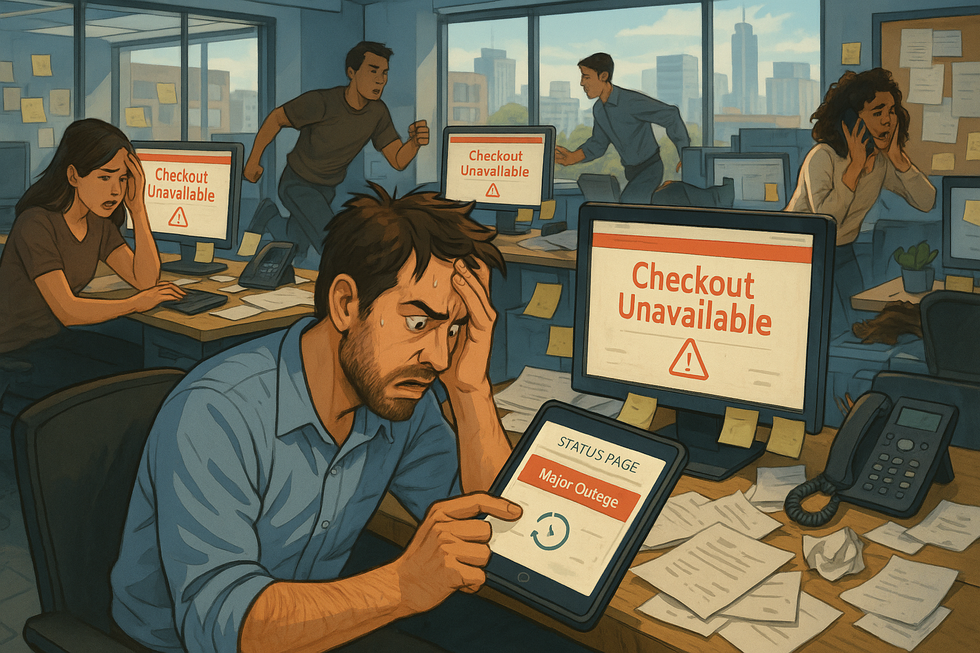
For online merchants, few phrases chill the blood quite like checkout unavailable. A Shopify outage affecting storefronts, payment flows and admin access did exactly that, turning what is usually invisible infrastructure into the day’s main character. Customers found pages slow or unreachable, some checkouts failed to complete, and merchants attempting to manage orders or inventory were met with the modern equivalent of a locked office door.
The disruption was a reminder that e-commerce, for all its polish and automation, still depends on a long chain of systems behaving themselves at the same time. When one link falters, the effects are immediate: carts are abandoned, support inboxes swell, and business owners begin refreshing status pages with the intensity of air-traffic controllers. 🛒
Key insight: In retail, an outage is not merely a technical event. It is a sales event, a customer-service event and, for small businesses, often a cash-flow event.
A platform outage with street-level consequences ⚠️
Shopify sits behind a vast number of online stores, from tiny kitchen-table brands to international retailers. Its appeal is precisely that it absorbs much of the complexity: hosting, payments, inventory tools, analytics, order management and themes are bundled into a relatively elegant package. But that convenience also creates concentration. When Shopify stumbles, thousands of merchants can feel the jolt at once.
During the outage, the most painful reports centered on three areas: customer-facing storefronts, checkout completion and access to the merchant admin panel. Each of those failures carries a different kind of damage. A storefront issue stops browsing. A checkout issue stops revenue. An admin issue stops merchants from fixing things, communicating clearly or processing what did get through.
-
Storefront disruption can prevent customers from viewing products, loading pages or adding items to carts.
-
Checkout disruption can block payment, create duplicate attempts or lead shoppers to abandon purchases altogether.
-
Admin disruption can prevent merchants from updating inventory, fulfilling orders or posting notices to customers.
In the physical world, a shopkeeper can tape a handwritten note to the door. Online, the note often has to be posted through the very system that has stopped cooperating. That is the particularly cruel little joke of platform dependency. 😬
The anatomy of e-commerce frustration 🧩
Outages rarely feel orderly to the people living through them. A status page may say “investigating,” a dashboard may partially load, one store may work while another fails, and customers may experience different problems depending on location, payment method, browser or timing. To engineers, that is the familiar fog of distributed systems. To merchants, it looks like chaos wearing a lanyard.
Modern commerce platforms are not single machines humming in a cupboard. They are sprawling ecosystems of databases, content delivery networks, authentication services, payment gateways, APIs, third-party apps and background jobs. A fault in one area can ripple outward in subtle ways. A checkout page might load, but payment authorization may fail. An admin panel might open, but order data may not refresh. A storefront might appear healthy until the customer clicks “buy.”
“The danger in e-commerce outages is that partial failure can be more confusing than total failure. Merchants may not know whether they are losing all orders, some orders or only orders from certain routes through the system.”
That uncertainty is expensive. Business owners must decide whether to pause ads, alert customers, extend promotions, contact support, or simply wait. The trouble is that waiting feels suspiciously like doing nothing, even when it is the only rational move. 🔧
Small merchants feel the outage first 💸
For large retailers, downtime is serious but often cushioned by teams, tools and contingency plans. For small merchants, the margin for disruption is thinner. A boutique running a product launch, a creator selling limited inventory, or a family business depending on daily orders may experience an outage not as an inconvenience but as a direct hit to the week’s revenue.
The timing of such disruptions can be especially unforgiving. If an outage coincides with a flash sale, a paid advertising campaign, an influencer mention or seasonal demand, the lost opportunity is difficult to recover. A customer who cannot check out at noon may not return at three. Online attention is a hummingbird; it does not wait politely on the branch.
-
Paid campaigns may continue sending traffic to stores that cannot convert visitors into buyers.
-
Customer trust can suffer if shoppers believe a brand’s site is unreliable or unsafe.
-
Support volume can spike as customers ask whether orders were placed or payments processed.
-
Operations can stall when merchants cannot access orders, shipping labels or inventory controls.
The cruelest part is that merchants may take the blame for infrastructure they do not control. To the customer, the store is the store. Few shoppers distinguish between a brand’s operations, Shopify’s platform, a payment processor and a third-party app. They simply know the checkout did not work. 🧾
Communication becomes the emergency tool 📣
In any outage, the quality of communication matters almost as much as the speed of restoration. Merchants need clear updates, not only reassurance. They need to know what is affected, what is not, whether transactions are safe, whether orders are being queued, and whether customers should retry purchases.
For platforms like Shopify, the challenge is scale. A single update must serve technically fluent developers, anxious store owners, enterprise clients and part-time sellers who simply need to know whether they should keep tonight’s sale live. Too much jargon alienates; too little detail frustrates. The best outage communication is plain-spoken, time-stamped and humble.
Key insight: During downtime, merchants are not asking for poetry. They are asking for facts, intervals and a believable sense that someone competent has a hand on the wheel.
Merchants, too, have their own communication burden. When possible, they should use email lists, social channels and pinned posts to let customers know if ordering is temporarily affected. A short, honest message can prevent confusion from hardening into mistrust. Silence, by contrast, tends to invite speculation, and speculation is rarely kind. 📨
The hidden dependency problem 🔗
The outage also highlights a broader truth about modern digital business: independence online is often built on rented foundations. Merchants may own their brand, their product and their audience, but the machinery of selling is usually leased from platforms, processors, logistics firms and software vendors.
This is not a criticism of Shopify alone. It is the architecture of the internet economy. Platforms create enormous efficiencies. They let entrepreneurs launch quickly, accept payments securely and operate without hiring an engineering department. But every layer of convenience comes with a dependency, and every dependency deserves a plan.
-
Maintain external customer channels, such as an email list or social presence, so customers can be reached if the storefront fails.
-
Keep key business records accessible outside the platform where appropriate, including recent order exports and inventory snapshots.
-
Monitor platform status pages and subscribe to incident notifications rather than relying on rumors.
-
Prepare simple outage messaging in advance so staff are not improvising under pressure.
-
Review app dependencies, because third-party integrations can complicate recovery and diagnosis.
None of these steps eliminates platform risk. They do, however, turn panic into procedure, which is one of civilization’s more underrated achievements. 🛠️
Trust is built in uptime and tested in downtime 🕰️
Customers tend to notice reliability only when it disappears. A smooth checkout feels ordinary, even though it is a minor miracle of authentication, encryption, inventory calls and payment authorization. But a failed checkout feels personal. It interrupts desire at the exact moment it was about to become a purchase.
For Shopify, the stakes are reputational as well as technical. The company’s promise to merchants is not merely software; it is continuity. When merchants build their livelihoods on a platform, they are buying confidence. Every major disruption asks whether that confidence was well placed.
To be fair, no large platform can promise permanent perfection. The serious question is not whether outages will ever happen, but how often they happen, how quickly they are resolved, how transparently they are explained, and what is learned afterward. Post-incident reviews, infrastructure investment and clearer merchant guidance are not glamorous, but they are the masonry of trust. 🧱
“Reliability is not a feature users celebrate every day. It is the quiet contract that allows every other feature to matter.”
What merchants should take away 🧭
The Shopify outage was disruptive, but it was also instructive. It showed how deeply commerce has moved from the shop floor to the server rack, and how quickly an invisible technical fault can become visible in sales figures, customer messages and operational delays.
Merchants should resist the temptation to treat outages as rare weather events that simply pass overhead. They are part of the operating environment. The sensible response is not alarmism, but preparedness: know your dependencies, diversify your communication channels, preserve access to essential records and rehearse what to tell customers when the digital lights flicker.
For shoppers, the episode is a glimpse behind the curtain. For merchants, it is a business continuity lesson delivered in real time. And for platforms, it is a reminder that their customers are not merely users clicking around dashboards. They are businesses with payrolls, rent, inventory, ambition and, on outage days, an understandable desire to see the checkout button work as advertised. ✅