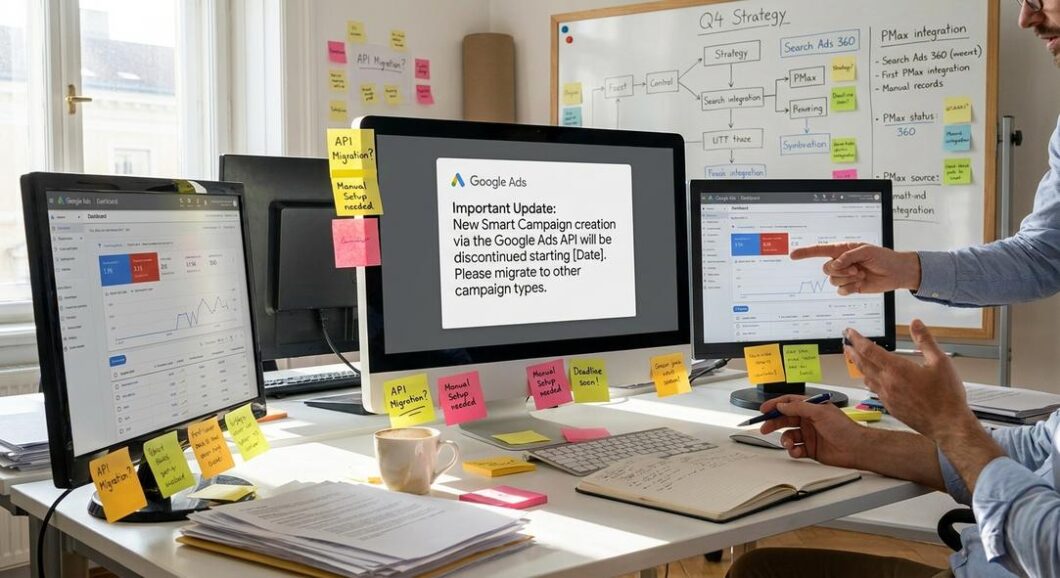
Google Ads API closes a door on new Smart Campaign creation 🚪📣
Google is preparing to stop supporting the creation of new Smart Campaigns through the Google Ads API, a change that may sound narrow and technical at first glance but carries a much wider message for advertisers, agencies, and software platforms.
For years, Smart Campaigns have occupied a peculiar corner of the Google Ads universe. They were designed for small businesses that wanted something simpler than the full machinery of Search, Display, bidding strategies, keyword structures, asset groups, and conversion modeling. In plain terms: less cockpit, more automatic transmission.
Now, by removing the ability to create new Smart Campaigns via the API, Google is nudging developers and advertisers away from one simplified lane and toward campaign types that better fit its current automation-first advertising architecture. The move is less a dramatic demolition than a quiet renovation, but anyone who builds tools on top of Google Ads should pay close attention.
Key insight: This is not merely an API housekeeping update. It reflects Google’s larger shift from “simple campaigns for small advertisers” toward broader automated systems that can be managed, measured, and optimized at scale.
What is actually changing? 🛠️
The central change is straightforward: developers using the Google Ads API will no longer be able to create new Smart Campaigns once support is removed. Existing Smart Campaigns may still need to be managed depending on Google’s transition rules, but the creation pathway is closing.
That distinction matters. API changes rarely land like thunderclaps for the average shop owner buying ads for a plumbing service or neighborhood bakery. They land first in the dashboards, connectors, scripts, workflows, and onboarding tools built by agencies and ad-tech vendors.
If a platform currently offers “create a Smart Campaign” as a one-click option, that feature will need to be reconsidered. If an agency has automated local campaign setup for clients using Smart Campaign templates, that process may require a new campaign architecture. If an internal tool depends on Smart Campaign creation for onboarding less sophisticated advertisers, it is time to revisit the blueprint.
What advertisers should not assume ⚠️
-
Do not assume that Smart Campaigns are disappearing overnight.
-
Do not assume existing campaigns will immediately stop serving.
-
Do not assume API access and Google Ads interface behavior will always change in exactly the same way at the same time.
-
Do not assume a simple campaign type will always have a simple migration path.
The sensible course is to check Google’s official documentation, release notes, and account-level notifications. In the world of advertising APIs, the fine print is not decoration; it is the operating manual.
Why Smart Campaigns mattered in the first place 🌱
Smart Campaigns were built around a promise that has long animated digital advertising: you do not need to be an expert to participate. For small businesses, that promise was powerful. A business owner could provide basic information, a website, a location, a few themes, and a budget. Google’s systems would handle much of the rest.
This made Smart Campaigns appealing to advertisers who did not know what match types were, did not want to debate bid strategies, and had no appetite for building granular keyword lists at midnight after closing the till.
But simplicity has always come with a bargain. Advertisers received ease of use in exchange for reduced control. Less manual steering meant fewer levers to pull when performance drifted. Smart Campaigns were friendly, but they were also something of a sealed box.
Smart Campaigns solved a real problem: many businesses wanted ads, not an apprenticeship in performance marketing. The challenge is that modern advertising increasingly demands both automation and accountability.
The bigger pattern: Google’s automation era 🤖
This update fits neatly into Google’s broader advertising direction. Over the past several years, Google has steadily emphasized automation, machine learning, conversion-based optimization, and campaign types that operate across inventory rather than staying neatly fenced inside old categories.
Performance Max is the most obvious symbol of that era. It promises access across multiple Google channels, powered by signals, assets, conversion goals, and automated bidding. Whether one sees it as a marvel of machine learning or a black box wearing a velvet jacket depends largely on experience, measurement discipline, and tolerance for ambiguity.
By contrast, Smart Campaigns belong to an earlier chapter of automation: automation as simplification. Google’s current direction is automation as orchestration. The difference is subtle but important. One helps advertisers avoid complexity; the other absorbs complexity into a larger system.
From simple setup to full-funnel machinery 📊
-
Smart Campaigns emphasized ease, local intent, and quick setup.
-
Modern automated campaigns emphasize conversion goals, audience signals, creative assets, and cross-channel reach.
-
API-driven platforms must now align with campaign types that Google is actively expanding rather than those it is gradually limiting.
That shift is not accidental. Google wants advertisers feeding its systems with better conversion data, stronger creative assets, and clearer business goals. In return, it offers reach and optimization that would be difficult to reproduce manually. The bargain is attractive, but not frictionless.
What this means for developers and platforms 💻
For developers, this is the practical heart of the matter. If an application currently supports Smart Campaign creation, the roadmap needs updating. This may involve disabling creation workflows, changing user interface language, mapping customers toward other campaign types, and revising documentation.
The least glamorous work will be among the most important: error handling, user messaging, dependency checks, and migration logic. Nobody writes a launch announcement for “we fixed the confusing failure state,” but customers certainly notice when a button stops working without explanation.
Platforms should also examine whether they have hard-coded assumptions around Smart Campaign resources, budget setup, business profile integrations, local targeting, or reporting fields. API deprecations have a way of exposing old architectural shortcuts like low tide revealing bicycles in a canal.
Developer takeaway: Treat this as a product change, not just an engineering ticket. Users need guidance, not merely a disabled endpoint.
A practical checklist for teams ✅
-
Audit all workflows that create Smart Campaigns through the Google Ads API.
-
Identify customers, accounts, or onboarding paths that rely on those workflows.
-
Review Google’s official timeline and version-specific API guidance.
-
Prepare alternative campaign creation paths where appropriate.
-
Update help center content, sales scripts, and support macros.
-
Build clear in-product messaging so users understand what changed and why.
What agencies should tell clients 🧭
Agencies have a delicate job whenever Google changes the machinery. Clients do not want a lecture on API support. They want to know whether their ads will keep running, whether leads will suffer, and whether someone competent is watching the dashboard.
The best client message is calm, specific, and free of melodrama. Smart Campaign creation through the API is being phased out, but that does not automatically mean every Smart Campaign is doomed or that performance will fall off a cliff by breakfast. It does mean future campaign setup may change.
Agencies should explain that Google’s advertising ecosystem is moving toward more advanced automated campaign types and that account structure may need to evolve accordingly. The emphasis should be on continuity: preserving business goals, measurement, budgets, and performance learnings while adapting the technical method.
Useful client framing 🗣️
-
“Your goals are not changing.” The campaign type may shift, but the business objective remains central.
-
“We are reviewing the best replacement path.” Not every advertiser needs the same solution.
-
“Measurement matters more than ever.” Strong conversion tracking helps automation perform responsibly.
-
“This is part of a broader Google Ads evolution.” It is not an isolated glitch or emergency.
The small-business question 🏪
The most interesting question is what this means for small businesses, the original audience for Smart Campaigns. Many of them did not choose Smart Campaigns because they loved automation theory. They chose them because they had invoices to send, staff to manage, and only so many hours in the day.
If Smart Campaign creation becomes less available through third-party tools, small advertisers may increasingly be guided toward other Google Ads campaign types. That can be positive if it leads to better performance, richer reporting, and more flexible optimization. It can also be challenging if setup becomes more complex or if advertisers are pushed into systems they do not fully understand.
The danger is not automation itself. Automation can be immensely useful. The danger is automation without transparency, weak measurement, or poor expectations. A campaign that is easy to launch but hard to evaluate is not truly simple; it is merely polite at the front door.
For small businesses: The future is not “do everything manually.” It is “use automation with enough understanding to know whether it is helping.”
How to think about alternatives 🔄
There is no universal replacement for Smart Campaign creation because advertisers vary widely. A local dentist, an e-commerce retailer, a regional home services company, and a national software firm do not need the same campaign structure.
For some businesses, a more conventional Search campaign may offer the right balance of control and intent. For others, Performance Max may be appropriate if conversion tracking, creative assets, and business goals are mature enough. Local objectives may require particular care, especially where calls, direction requests, store visits, or service-area leads are the real measure of success.
The important thing is not to swap one campaign type for another as if changing light bulbs. Advertisers should begin with the business goal, then choose the campaign architecture that serves it.
Questions to ask before migrating or rebuilding 🔍
-
What is the primary conversion action: calls, forms, purchases, visits, bookings, or something else?
-
Is conversion tracking accurate and complete?
-
Does the advertiser have strong creative assets available?
-
Is geographic targeting local, regional, national, or mixed?
-
How much control does the advertiser or agency need over queries, placements, budgets, and messaging?
-
What reporting does the client actually use to make decisions?
A quiet change with loud implications 📌
API updates can seem bloodless, the sort of thing announced in documentation and digested by engineers over coffee. But they often reveal where a platform is heading. In this case, Google is signaling that Smart Campaigns are no longer the preferred creation path for API-driven advertising tools.
That does not mean advertisers should panic. It does mean developers should prepare, agencies should communicate, and businesses should understand that the age of “set it and forget it” advertising was always a little mythical. The machine may do more of the work, but humans still need to decide what success looks like.
The end of new Smart Campaign creation via the Google Ads API is, in one sense, a technical sunset. In another, it is a reminder that digital advertising never sits still for long. Today’s shortcut becomes tomorrow’s legacy feature; today’s best practice becomes tomorrow’s migration plan.
The bottom line: Google is not stepping away from automation. It is refining where that automation lives, how it is accessed, and which campaign models it wants the advertising ecosystem to build around next.